
What citrulline is
Citrulline is an amino acid your body makes in the gut and converts to arginine in the kidneys. Arginine is the raw material for nitric oxide, the signal that tells blood vessels to widen. That is the chain a pre-workout is selling when it promises a pump: citrulline, arginine, nitric oxide, blood flow.
The reason the supplement is citrulline and not arginine is absorption. Most arginine you swallow is broken down in the gut and the liver before it reaches the blood. Citrulline is not, and in a pharmacokinetic study it raised arginine in the blood more effectively than the same amount of arginine did. Citrulline malate is citrulline bound to malic acid, usually two parts to one; the malate is there for the taste and for a theory about energy production that has not been shown to matter.
What the trials found
The study that made citrulline malate a pre-workout ingredient was a bench press trial from 2010. Forty-one men took 8 grams of citrulline malate or a placebo an hour before eight sets to failure at 80 percent of their maximum. On citrulline they did more repetitions from the third set on, and in the last set about 50 percent more. Their soreness at 24 and 48 hours afterwards was about 40 percent lower. One in seven reported stomach discomfort.
That result has been chased for fifteen years with mixed luck. A meta-analysis in Sports Medicine pooled twelve studies and found a small, significant gain in strength and power. A second meta-analysis, of eight studies on repetitions in strength training, also found a small benefit. In between, a careful trial with German Volume Training, ten sets of ten, found that 8 grams of citrulline malate improved nothing and did not reduce soreness. A critical review in 2021 concluded that the evidence is inconsistent and that the strong early result has not been reproduced in that size.
The honest size of it
Read the small pooled effect as a few repetitions across a session of hard sets, on some days, in some people. A pump is likely; a different session is not. On soreness the original result stands mostly alone.
The dose
The trials used 8 grams of citrulline malate, which is about 5 grams of citrulline, taken 40 to 60 minutes before training. Smaller doses have not been shown to do the same, and reviews of citrulline on its own put the working range at 3 to 6 grams of pure citrulline.
That is the number to hold against a label. Most scoops hold less. A serving with 5 grams of citrulline malate carries about 3.3 grams of citrulline, below the studied dose; a serving with 3 grams carries 2. The ratio matters too: a label that says citrulline malate 1:1 holds less citrulline than one that says 2:1 at the same weight.
When to take it, and when not
Forty to sixty minutes before the session, as in the trials, on the days you train. There is no loading and no reason to take it on rest days: the effect, where it exists, is acute.
It is not for a set of five. The trials where it did something were long sets to failure, and the mechanism, blood flow, is about work under fatigue. It is also not for anyone on medication that affects blood pressure or the heart without asking a doctor, because nitric oxide widens blood vessels in the rest of the body too.
Where it sits in the system
A pre-workout fixes nothing a plan does not. Citrulline is the one stim-free ingredient at a dose close to working in most products, and even then it is a small edge on long sets, after the protein target, creatine, sleep and a programme that progresses. A coffee an hour before training has stronger evidence behind it and costs less; the stim-free pre-workout guide sets both against the label.
If you want the whole week built and not one scoop of it, that is what adding muscle looks like inside the system, and the Structure Assessment shows where yours has a gap.
Questions
What is the difference between citrulline and citrulline malate?
Citrulline malate is citrulline bound to malic acid, usually two parts citrulline to one part malate. The citrulline is the active part for blood flow. Whether the malate adds anything of its own is not settled; most trials used the malate form at 8 grams.
How much citrulline malate should I take?
The dose in the trials is 8 grams of citrulline malate, 40 to 60 minutes before training. Smaller doses have not been shown to do the same. Check how many grams your scoop holds, and whether the figure is citrulline or citrulline malate.
Does citrulline give a pump?
It raises arginine and nitric oxide, which widens blood vessels, so a fuller feeling in the muscle is plausible and often reported. The measured effects in trials are on repetitions and soreness, not on the pump itself.
Is citrulline better than arginine?
For raising arginine in the blood, yes. Oral arginine is largely broken down in the gut and liver before it reaches the blood; citrulline is not, and is converted to arginine in the kidneys. That was shown directly in a pharmacokinetic study.
Are there side effects?
Stomach discomfort in a minority: about one in seven in the original bench press trial reported it. Nothing else is consistently reported at 8 grams. If you take medication for blood pressure or the heart, ask a doctor first.
From the Struqture range
Struqture sells this product. What the article says about the ingredient stands apart from that: see the editorial policy.
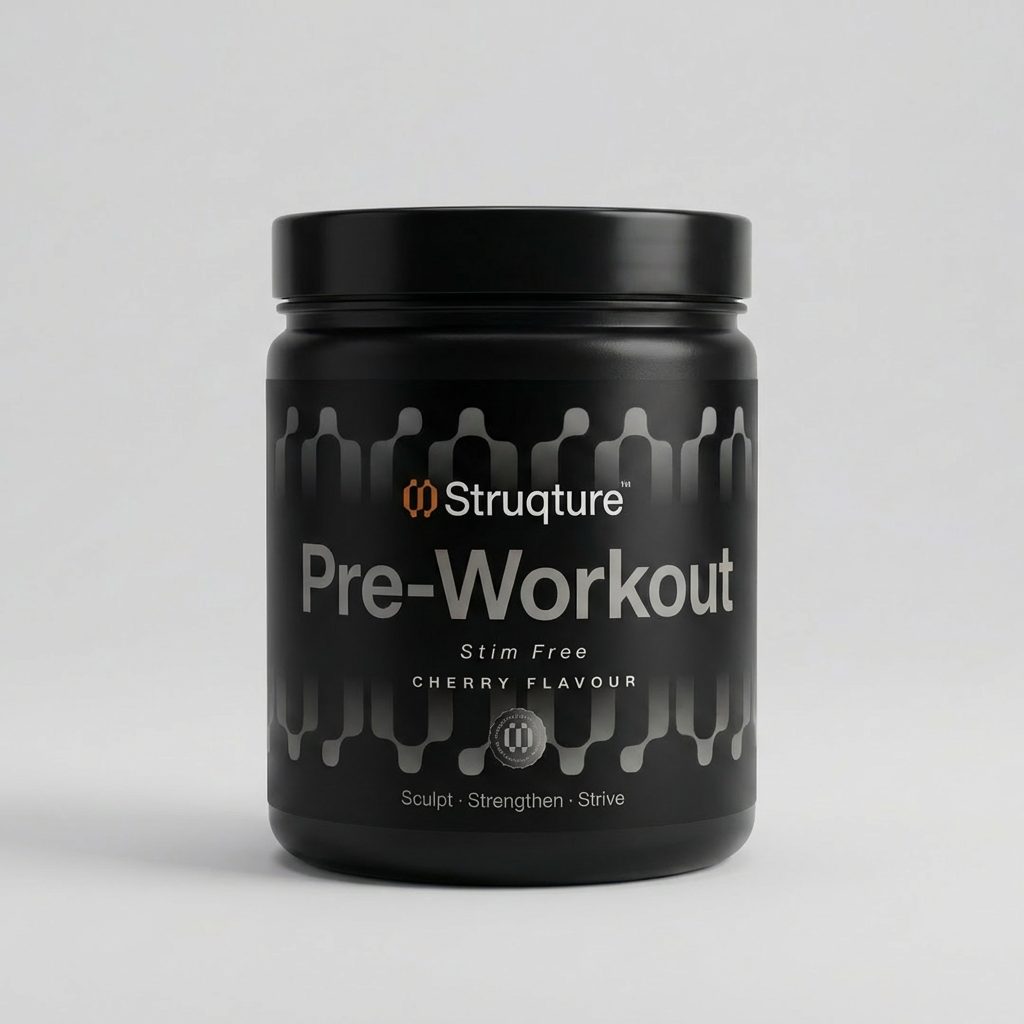
Pre-Workout
Cherry, stim free
Session quality without the stimulant. Citrulline, beta-alanine and bicarbonate at working doses, so the evening session gets the same output as the morning one.
R 230
Sources
- Schwedhelm E, Maas R, Freese R, et al. Pharmacokinetic and pharmacodynamic properties of oral L-citrulline and L-arginine: impact on nitric oxide metabolism. British Journal of Clinical Pharmacology. 2008;65(1):51-59.
- Pérez-Guisado J, Jakeman PM. Citrulline malate enhances athletic anaerobic performance and relieves muscle soreness. Journal of Strength and Conditioning Research. 2010;24(5):1215-1222.
- Trexler ET, Persky AM, Ryan ED, Schwartz TA, Stoner L, Smith-Ryan AE. Acute effects of citrulline supplementation on high-intensity strength and power performance: a systematic review and meta-analysis. Sports Medicine. 2019;49(5):707-718.
- Vårvik FT, Bjørnsen T, Gonzalez AM. Acute effect of citrulline malate on repetition performance during strength training: a systematic review and meta-analysis. International Journal of Sport Nutrition and Exercise Metabolism. 2021;31(4):350-358.
- Chappell AJ, Allwood DM, Johns R, et al. Citrulline malate supplementation does not improve German Volume Training performance or reduce muscle soreness in moderately trained males and females. Journal of the International Society of Sports Nutrition. 2018;15:42.
- Gonzalez AM, Trexler ET. Effects of citrulline supplementation on exercise performance in humans: a review of the current literature. Journal of Strength and Conditioning Research. 2020;34(5):1480-1495.
- Gough LA, Sparks SA, McNaughton LR, et al. A critical review of citrulline malate supplementation and exercise performance. European Journal of Applied Physiology. 2021;121(12):3283-3295.
Sources checked on 19 October 2026. This article is general information for experienced lifters, not medical or dietary advice for your situation. See a doctor about a medical condition or medication. How Struqture writes and checks its articles, disclaimer.