
What beta-alanine is
Beta-alanine is an amino acid your body uses to make carnosine, and carnosine is stored in muscle, where it buffers acid. During a hard effort that lasts longer than a few seconds, hydrogen ions build up in the muscle, and that is part of the burn that makes the last repetitions of a long set slow down. Carnosine soaks some of it up.
Beta-alanine itself does nothing in the session. What it does is raise the carnosine store over time. That is the whole mechanism, and it decides everything about how to take it.
How the store is built
The first studies on it were done at the University of Chichester. In one of them, men took 4 to 6.4 grams of beta-alanine a day; after four weeks their muscle carnosine had risen by about 60 percent, after ten weeks by about 80 percent. Their time to exhaustion on a hard cycling test rose with it, by 13 percent at four weeks and 16 percent at ten.
Two things follow. The dose is daily, training day or not, because the store is built between sessions, not during them. And it is slow: the position stand of the International Society of Sports Nutrition puts the working dose at 4 to 6 grams a day for at least four weeks. Once the store is up, it comes down slowly too; the washout after loading takes weeks to months.
What it does for performance
The evidence is broad and the effect is small. A meta-analysis in the British Journal of Sports Medicine pooled 40 studies: beta-alanine improved exercise performance overall, and the benefit sat in efforts of about 30 seconds to 10 minutes. An earlier meta-analysis of 15 studies found the same shape: a gain in efforts of one to four minutes, and no measurable effect on anything under a minute.
For a lifter, that is a precise description of where it helps. A set of twenty on the leg press, a hard interval, a conditioning finisher, the last minute of a long set under fatigue. It is not a set of five, which ends for a different reason, and it is not a strength supplement.
The honest size of it
The pooled effect in the large meta-analysis was small. Read that as a modest gain on long, burning efforts after a month of daily dosing, and nothing before that. Creatine, by comparison, is a smaller daily dose with a broader effect; if you take one, take that one first.
The tingle
Beta-alanine is the ingredient that makes a pre-workout tingle. The feeling is called paraesthesia: pins and needles in the face, neck, arms or back, starting within twenty minutes of a dose and fading within an hour. It is harmless, and it is the only side effect the research reports.
It depends on the amount in one go. In the first absorption study, a single dose of 10 milligrams per kilogram of body weight, about 800 milligrams for an 80 kilogram lifter, caused no symptoms; 20 and 40 milligrams per kilogram did. A serving of 2 grams is 25 milligrams per kilogram for that lifter, which is why most people feel it. Splitting the daily dose into smaller servings or using a slow-release tablet reduces the tingle without reducing the loading.
Where it sits in a pre-workout
Most stim-free pre-workouts, including ours, carry 1.6 to 2 grams of beta-alanine per serving, taken on training days. That dose does two things: it gives the tingle, and it contributes to the daily total if you also take beta-alanine on the other days. On its own, three or four servings a week do not reach the 28 to 42 grams a week the research loads with.
So decide what you want from it. If you want the carnosine effect for high-rep work or conditioning, take 4 to 6 grams a day, every day, in two or three servings, for a month before judging it. If you take a pre-workout for the citrulline and accept the tingle as the price, that is a fair choice too; just do not expect the beta-alanine in it to do more than tingle.
Where it sits in the system
Beta-alanine is a long way down the list. The protein target, creatine, sleep and a programme that progresses carry the result; the six signals I read every week do not change because of a buffer in the muscle. For a lifter who does long sets or conditioning and has the rest in place, it is a small, well-studied edge. For everyone else it is an itch.
If you want the whole week built and not one scoop of it, that is what adding muscle looks like inside the system, and the Structure Assessment shows where yours has a gap. For the pre-workout itself, the stim-free pre-workout guide sets every ingredient against its dose.
Questions
Why does beta-alanine make my skin tingle?
The tingling is paraesthesia, a harmless reaction to a dose of beta-alanine taken in one go. In the first absorption study a single dose of 10 milligrams per kilogram caused none, and 20 and 40 milligrams per kilogram did. It starts within twenty minutes and fades within an hour. Divided doses and slow-release tablets reduce it.
Does the tingling mean it is working?
No. The tingle shows that beta-alanine is in your blood, not that your carnosine has risen. The performance effect needs weeks of daily dosing; the tingle happens from the first serving.
How much beta-alanine do I need?
Four to six grams a day for at least four weeks, according to the position stand of the International Society of Sports Nutrition. Spread over the day it is better tolerated. One serving on training days does not reach that.
Is beta-alanine safe?
At the recommended doses, yes, for healthy people: the only reported side effect is the tingling. There is no long-term data on years of use, and the position stand says so. If you have a medical condition or take medication, ask a doctor first.
Does beta-alanine help with heavy sets of five?
Not measurably. The meta-analyses find the effect in efforts of about one to four minutes. A heavy set lasts seconds and is limited by something else.
From the Struqture range
Struqture sells this product. What the article says about the ingredient stands apart from that: see the editorial policy.
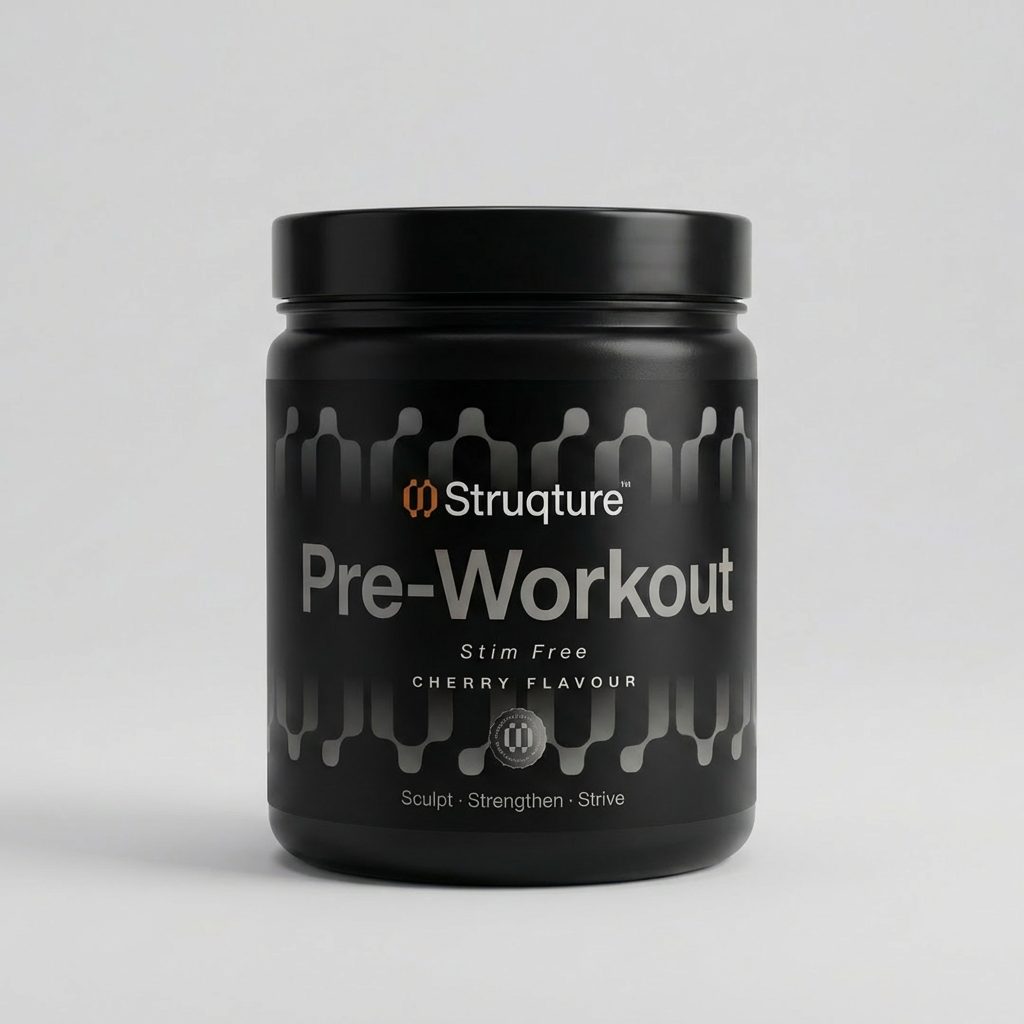
Pre-Workout
Cherry, stim free
Session quality without the stimulant. Citrulline, beta-alanine and bicarbonate at working doses, so the evening session gets the same output as the morning one.
R 230
Sources
- Trexler ET, Smith-Ryan AE, Stout JR, et al. International Society of Sports Nutrition position stand: beta-alanine. Journal of the International Society of Sports Nutrition. 2015;12:30.
- Saunders B, Elliott-Sale K, Artioli GG, et al. β-alanine supplementation to improve exercise capacity and performance: a systematic review and meta-analysis. British Journal of Sports Medicine. 2017;51(8):658-669.
- Hill CA, Harris RC, Kim HJ, et al. Influence of β-alanine supplementation on skeletal muscle carnosine concentrations and high intensity cycling capacity. Amino Acids. 2007;32(2):225-233.
- Harris RC, Tallon MJ, Dunnett M, et al. The absorption of orally supplied β-alanine and its effect on muscle carnosine synthesis in human vastus lateralis. Amino Acids. 2006;30(3):279-289.
- Décombaz J, Beaumont M, Vuichoud J, Bouisset F, Stellingwerff T. Effect of slow-release β-alanine tablets on absorption kinetics and paresthesia. Amino Acids. 2012;43(1):67-76.
- Hobson RM, Saunders B, Ball G, Harris RC, Sale C. Effects of β-alanine supplementation on exercise performance: a meta-analysis. Amino Acids. 2012;43(1):25-37.
- Baguet A, Reyngoudt H, Pottier A, et al. Carnosine loading and washout in human skeletal muscles. Journal of Applied Physiology. 2009;106(3):837-842.
Sources checked on 19 October 2026. This article is general information for experienced lifters, not medical or dietary advice for your situation. See a doctor about a medical condition or medication. How Struqture writes and checks its articles, disclaimer.